From ancient castles and historic forts to cosy pubs and old manor houses, the Suffolk Coast has a rich history filled with ghostly goings-on and unexplained encounters.
Whether you believe in the supernatural or simply love a good ghost story, these haunted places are steeped in legends that have lingered for generations. Here are some of the spookiest spots along the coast and beyond...
Bungay Castle

Dating back to the 12th century, Bungay Castle was built by Roger Bigod, Earl of Norfolk, and its imposing ruins have a history steeped in legend. The castle is said to be haunted by Hugh, a member of the powerful Bigod family, whose spirit is rumoured to linger among its ancient walls.
Bungay is also closely associated with Black Shuck, Suffolk’s legendary phantom hound. According to local folklore, during a violent storm in 1577, the enormous black dog burst into St Mary’s Church in Bungay, killing a man and a boy before continuing to nearby Blythburgh, where it is said to have claimed more lives.
The legend lives on through the dark scorch marks on the door of Holy Trinity Church in Blythburgh, traditionally believed to be the devil’s fingerprints left behind by the fearsome beast. Whether you believe the tales or not, Bungay’s history offers plenty to send a shiver down your spine.
Blythburgh Church (Holy Trinity)
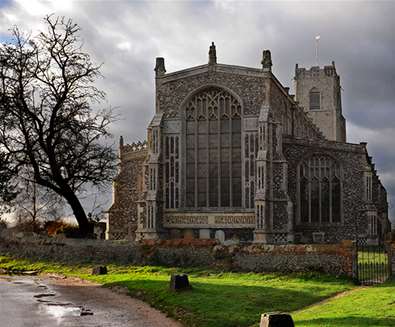
Overlooking the River Blyth, Holy Trinity Church in Blythburgh is steeped in local legend and famously associated with Black Shuck, Suffolk’s fearsome phantom hound. According to folklore, during a violent thunderstorm on 4 August 1577, the enormous black dog, with glowing red eyes, appeared at nearby St Mary’s Church in Bungay before making its way to Blythburgh. Here, it is said to have attacked parishioners, killing several people before the church steeple collapsed.
The legend lives on through the dark scorch marks on the church’s historic north door, known locally as the ‘devil’s fingerprints’. Said to have been left by Black Shuck as it fled, the marks can still be seen today. While the tale may have its roots in a real lightning strike and structural damage, the church remains one of the Suffolk coast’s most atmospheric locations for tales of the supernatural.
Buttermarket Shopping Centre, Ipswich

Built on the site of a former monastery and Anglo-Saxon burial ground, the Buttermarket Shopping Centre in Ipswich has more than its fair share of ghostly tales. CCTV footage from the underground car park is said to have captured shadowy figures, while former employees at Cowells Department Store and Cowells Printers reported sightings of a ghostly monk before the shopping centre was built.
And the stories don't end there. Near the emergency exit at the rear of the centre, a male apparition is said to charge towards unsuspecting passers-by before mysteriously vanishing into thin air. Perhaps one to keep in mind on your next shopping trip!
Roos Hall, Beccles

Said to be one of the most haunted houses in England, 16th Century Roos Hall is located just outside the historic market town of Beccles. This Tudor manor is steeped in ghostly folklore, including tales of a phantom coach and horses said to charge down the driveway and stop outside the front door on Christmas Eve.
Legend has it that the coach is driven by a member of the Blennerhassett family, who once owned the hall, with a beautiful ghostly woman seated beside him. According to the story, anyone who looks her directly in the eyes risks being driven mad.
The devil is also said to have left his mark on the hall, with scorch marks in the brickwork of a cupboard attributed to his presence. On the grounds, an old oak tree near the road is associated with tales of executions. Local legend tells of a woman dressed in white who appears at night, alongside the ghost of a man in a brown jacket and trousers who was hanged for stealing, only to be found not guilty after his death.
Today, Roos Hall remains a privately owned property, adding to the mystery surrounding one of Suffolk’s most intriguing haunted locations.
Christchurch Mansion, Ipswich

The Grade I-listed Christchurch Mansion in Ipswich is best known for its impressive collection of paintings by artists including John Constable and Thomas Gainsborough. But beyond its art and history, the Tudor mansion is also the subject of several ghostly tales.
One of the most frequently reported apparitions is a young Edwardian woman, said to dance and laugh in the Upper Gallery, sometimes accompanied by two cheerful children. Other visitors have told stories of a mysterious lady in a full-length grey gown who suddenly appears before them. There are also reports of a young servant girl, who is said to have died in unexplained circumstances, still wandering the mansion’s historic halls.
Dunwich

Once the capital of the Kingdom of the East Angles, the historic coastal town of Dunwich was gradually lost to coastal erosion, with much of the town slipping into the sea over the centuries. Local legend has it that, when the waves are rough, the bells of its lost churches can still be heard ringing beneath the water.
There are ghostly tales on land, too. Take a walk across Dunwich Heath after dark and, according to local folklore, you might encounter the spectral figure of a Victorian squire riding on horseback. Just keep an eye on the path ahead!
Landguard Fort, Felixstowe

With its long military history, it’s perhaps no surprise that Landguard Fort in Felixstowe has its fair share of ghost stories. Staff have reported several unexplained sightings, including a Victorian artilleryman who allegedly appeared in the gift shop one afternoon. He is said to have walked straight through the wall, smiled at a female member of staff, then disappeared back into it. The same figure has also been blamed for poltergeist activity, with items reportedly flying off the shelves without warning.
Outside the fort, there are tales of a ghostly horse-drawn coach crossing the ditch where the old drawbridge once stood. Inside, a spectral soldier believed to have been stationed there during the Second World War has reportedly been seen patrolling the Bastion. And if that weren’t eerie enough, listen closely and you might hear the agonised screams of a soldier who, according to legend, died of the plague while being held in quarantine at the fort.
Covehithe Ruins & St Andrew’s Church
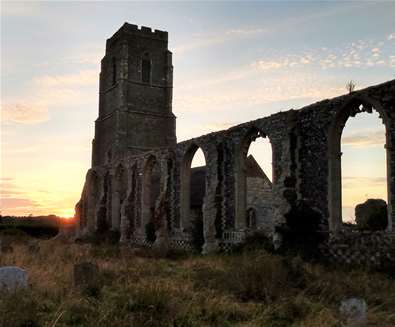
Once a glorious medieval church, St Andrew’s in Covehithe now stands in picturesque ruin on Suffolk’s rapidly eroding coastline. Its lofty 14th-century tower and sections of the original walls remain, while a smaller thatched-roof church, built in 1672, still nestles within the ruins and continues to serve the local community. With the North Sea steadily encroaching, this atmospheric landmark may not remain unchanged for much longer.
The ruins are also associated with tales of the ‘Faceless Lady’, a spectral figure dressed in heavy, dark clothing who is said to drift silently between the ancient gravestones and church arches. Those who claim to have seen her describe a smooth, featureless face, adding an eerie twist to this haunting corner of the Suffolk coast.
Potsford Gibbet, near Wickham Market
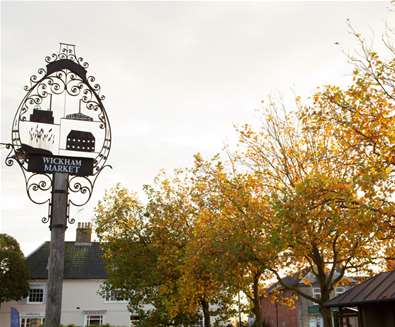
Hidden among the trees of Potsford Wood, near Wickham Market and Woodbridge, Potsford Gibbet is a site with a grim history dating back to the late 17th century. In 1698, local labourer Jonah Snell murdered his employer, John Bullard, and Bullard’s son at a nearby watermill. Snell was hanged on 14 April 1699, and his body was placed in an iron cage and suspended from a gibbet as a warning to others. According to local accounts, his remains were left hanging for more than 40 years before being buried at the foot of the post.
The site has since become associated with eerie tales of the supernatural. Visitors have reported strange lights flickering among the trees, unsettling groaning sounds and a sinister figure in a black cloak, whose hood is said to conceal a grinning, hollow-eyed skull. Whether rooted in the area’s dark history or local folklore, Potsford Gibbet remains one of Suffolk’s most unsettling haunted locations.